Follow the Landscape
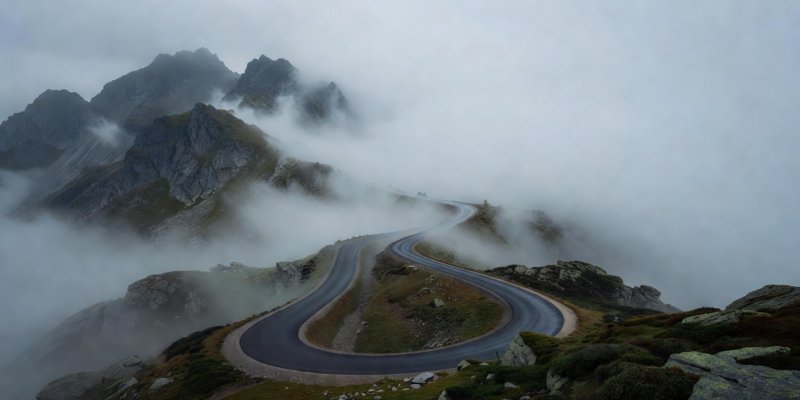
European roads are not merely infrastructure; they are historic achievements carved into difficult terrain. When you choose to leave the valley floors and follow the landscape, driving elevates from transit to an active physical pursuit. Selecting scenic routes requires an understanding of how topography influences your vehicle, your concentration, and your timeline.
The Geometry of Mountain Passes
Few driving experiences rival the ascent of a major European col. Routes like the Grossglockner High Alpine Road in Austria, the Stelvio Pass in Italy, or the sprawling Route des Grandes Alpes in France offer vast, sweeping panoramas and tight, rhythmic hairpin bends (tornanti). But these roads demand respect.
Driving on gradients significantly changes vehicle dynamics. On steep ascents, selecting the right gear keeps the engine in its power band, preventing sluggishness. More critically, on descents, relying solely on your brakes leads to overheating and brake fade—a highly dangerous situation on a 10% decline. Engine braking, by dropping into a lower gear and letting the engine's compression slow the car, is a mandatory technique for Alpine driving.
Alpine Driving Etiquette
The unwritten (and often written) rule of mountain driving is that the ascending vehicle has the right of way. In Switzerland, the yellow post buses always have priority, signaled by their distinct three-tone horn. Always monitor your mirrors; if a local driver is filling your rear-view mirror, use the next layby to let them pass. It relieves pressure on you and maintains the flow of traffic.
Tracing the Coastlines
Coastal drives, such as the Amalfi Drive (SS163) in Italy or the Wild Atlantic Way in Ireland, present an entirely different set of challenges. The views of the crashing sea and jagged cliffs are spectacular, but the roads are often painfully narrow, flanked by stone walls on one side and sheer drops on the other.
Coastal routes suffer heavily from seasonal congestion. In July and August, a scenic 50-kilometer stretch can take hours behind a caravan of motorhomes. To truly enjoy coastal driving, timing is everything. Begin your drive at dawn, before the tourist buses depart, or travel during the shoulder seasons (May, September) when the light is softer and the tarmac is quiet.
Forests and Rural Plains
Not all scenic roads require altitude. The dark, dense sweep of the Schwarzwaldhochstraße (Black Forest High Road) in Germany offers wide, sweeping curves through ancient timber, providing a rhythmic, flowing drive rather than the stop-start nature of hairpins. Similarly, driving through the expansive lavender fields of Provence or the rolling agricultural plains of Andalusia connects you to the historical rhythms of European agriculture.
When planning to follow the landscape, consider the vehicle you are driving. Wide SUVs might feel robust on the motorway, but they can be a liability on a narrow Scottish single-track road equipped with passing places. Conversely, a nimble compact car might lack sheer power but will dance lightly over an Italian pass.
Ultimately, a scenic road asks for your attention. Turn off the stereo, drop the windows slightly to hear the engine echo off the rock faces, and let the landscape lead the way.